
The growing importance of digital communication channels is no longer disputed. We've compiled 5 helpful tips on how you can utilize the associated opportunities and establish modern digital communication in your community.
Communication and information dissemination have changed dramatically in the last 30 years. Print media, once so reliable, are losing relevance. Surveys, such as the long-term study by ZDF and ARD entitled „50 Years of "Mass Communication": Trends in Media Use and Evaluation“ clearly demonstrate how digital formats have gained enormous relevance in recent years.

At the same time, municipalities face a difficult task. Besides the often inadequate technical training of their full-time staff, these employees must also manage a significantly wider age range in their communications than is the case in most companies or associations. Furthermore, many of the services already in use are... are not compliant with data protection regulations.
Below we have compiled five tips on how you can improve digital communication in your community.
1. Communication should be inclusive.
It is important that everyone, Anyone who wants to be informed should also be able to access that information. This idea sounds simple, but it represents the biggest problem in many communities. How do people in your community connect with others? How easy is it to get on the email list or end up in the right messenger group? Are current changes perhaps only communicated on Facebook?
You should ensure that everyone has easy access to all the latest news. The communication channel could be an email distribution list, social media pages, or your own website. App However, this channel must be clearly named and easy to access.
2. Communication should be interactive
Information has become not only digital but also interactive in recent years. Comment sections, Wikipedia, etc., have brought about a shift from the classic sender-receiver model: The receiver can now respond.
This form of interaction is no longer an add-on – users actually expect it. Therefore, it's important to use media that allow for this interaction. This starts with email distribution lists, extends to social media, and culminates in a dedicated app where visitors can post their own content.
To provide a safe space for this interaction, we recommend creating a Netiquette, on what basis you can moderate the content transparently.
3. Network channels
We've all been there – the church service change was announced on Facebook and via email, but the website still shows the wrong time. Keeping everything up-to-date is a real challenge, especially when managing multiple channels.
Networking services such as [examples of services would be helpful here] are helpful in this regard. Zapier, or social media bundling platforms such as Hootsuite. For example, you can connect the website to Facebook and Instagram so that the new blog post automatically appears on the social media channels as well.
Our Communi apps are also connected to over 1500 services via Zapier.
4. Communicate in an age-appropriate manner
Not every visitor is registered on Facebook, and not everyone owns a smartphone. The wide age range among church communities often necessitates "backwards compatibility." Specifically, this means that ideally, the app is also available as a website, Facebook posts appear on the blog, and if a service is canceled, this is announced in the church newsletter and on the church door.
For this reason, we deliberately designed our apps so that they are also accessible in the browser for visitors without a smartphone.
5. Choose channels tailored to the target audience
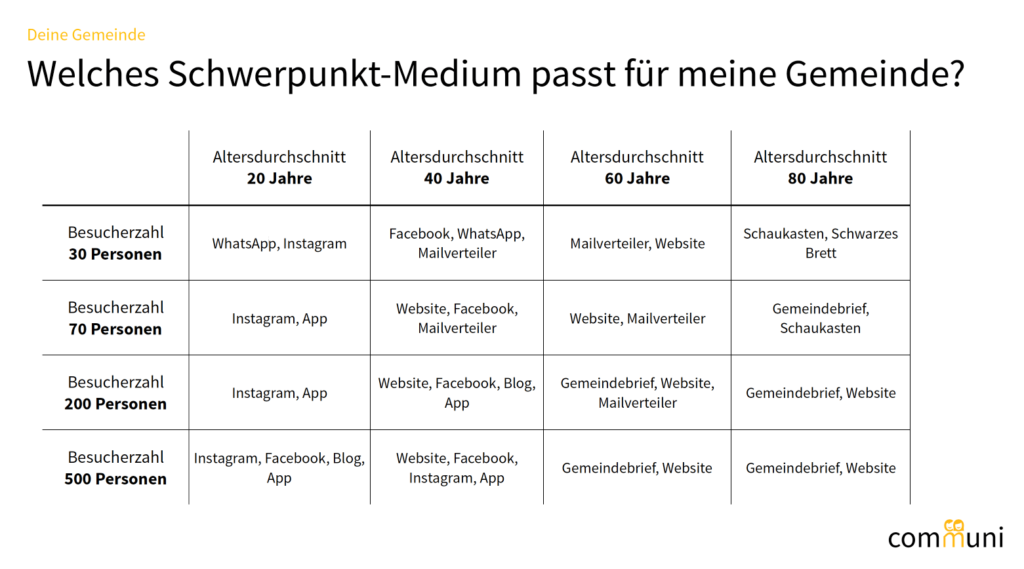
Communities are diverse. Therefore, not every community needs to, and should, use all channels. We recommend focusing on one to three key channels, depending on your main target audience and visitor numbers. Our recommendations are outlined in the table below:
About Communi
Five years ago, we had exactly this communication problem in our community: A lot was happening. People were meeting up to play football or have barbecues, but you only found out about it if you were in the right WhatsApp group.
Driven by this fact, we developed an app that was both inclusive and interactive, allowing users to stay informed about everything happening in the community without it being intrusive.
The app was developed in our church community, the CityChurch Würzburg, It was very well received. Due to demand from other municipalities, we finally founded Communi in 2017. Since then, every municipality can create its own app with just a few clicks, which is then made available in the app stores in its own colors and with its own name.
Could Communi be something for your community? Then create one now at communiapp.de/testapp your own app and test it for 30 days free of charge and without obligation.
Do you have your own tips for modern digital communication in communities? Then feel free to write to us at